Table of Contents
Imagine trying to predict which businesses will survive the next decade using the same math that calculates planetary orbits. Sounds absurd, right? Yet for over a century, this has been economics’ deepest ambition. The field has been chasing the ghost of Isaac Newton, hoping to discover eternal laws that govern markets the way gravity governs falling apples.
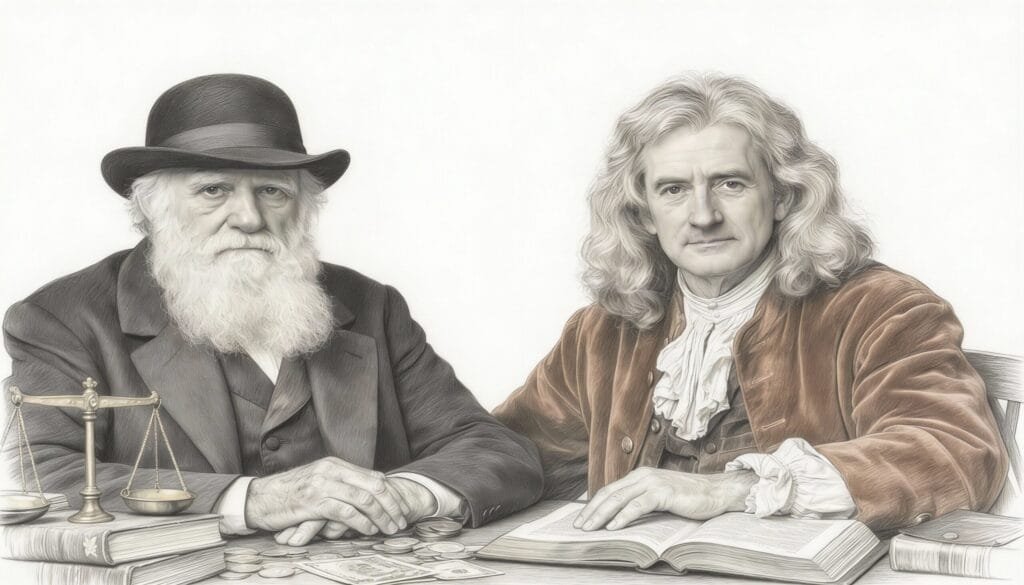
Richard Nelson, the economist who passed away recently, spent his career arguing we’ve been looking in the wrong direction. Economics doesn’t need its Newton. It needs its Darwin.
The Physics Obsession
The story begins in the late 1800s when economics was desperate for credibility. Physics was the king of sciences, elegant and precise. Economists like William Stanley Jevons and Léon Walras gazed enviously at physicists who could predict eclipses decades in advance with nothing but pencil and paper. They wanted that power.
So they borrowed. Heavily. They took the concept of equilibrium from thermodynamics. Think of a hot iron rod plunged into cold water. Energy flows from hot to cold until both reach the same temperature. Perfect balance. No more change. Economists saw markets the same way: buyers and sellers trading until prices settle at a point where everyone’s satisfied and the system rests in equilibrium.
The math was beautiful. Clean differential equations. Elegant proofs. The same tools that described planetary motion now described how people trade butter and bread. Economists could publish papers that looked indistinguishable from physics journals. Finally, respectability.
There was just one problem. Economies don’t work like planets.
When Beautiful Math Meets Messy Reality
Planets are predictable because they’re simple. Yes, calculating their trajectories requires sophisticated math, but at the core, you’re dealing with objects that follow laws. Earth doesn’t wake up one morning and decide it’s bored of orbiting the sun. Gravity doesn’t take weekends off.
People are different. Companies are different. An economy is seven billion humans with shifting wants, evolving technologies, changing social norms, new regulations, and the occasional pandemic. Trying to capture this with timeless equations is like trying to predict evolution with geometry.
Yet the physics approach became orthodoxy. Mainstream economics assumed firms maximize profits perfectly, markets reach equilibrium automatically, and the past doesn’t matter because everything returns to a natural state. These assumptions weren’t chosen because they were realistic. They were chosen because they made the math work.
Wassily Leontief, a Nobel laureate, saw this problem in the 1970s and coined a term for it: physics envy. Economics had become so obsessed with mathematical elegance that it lost touch with what economies actually do. The tools started dictating the questions rather than the other way around.
Enter Darwin (Through Nelson and Winter)
In 1982, Richard Nelson and Sidney Winter published a book that tried to reset the game. “An Evolutionary Theory of Economic Change” argued that if you want to understand how economies work, stop thinking about equilibrium and start thinking about evolution.
The insight is simple but radical. Economies don’t settle into stable states. They’re constantly moving, mutating, adapting. New firms emerge. Old firms die. Technologies spread. Practices get copied. Some businesses thrive not because they found the optimal strategy but because they stumbled onto something that worked in their particular moment and place.
This sounds obvious when you say it out loud. Of course businesses are more like organisms than planets. Of course competition is more like natural selection than thermodynamics. But economics had spent a century committed to the wrong metaphor.
Nelson and Winter proposed thinking about firms as having routines rather than optimization strategies. Routines are like organizational DNA. They’re the habits, procedures, and unwritten rules that determine how a company actually operates. When IBM decides how to develop new products, they’re not solving a calculus problem. They’re following routines they’ve developed over decades of trial and error.
These routines evolve. Successful firms survive and spread their practices. Unsuccessful ones disappear. The market doesn’t push everyone toward a single optimal equilibrium. It creates diversity, experimentation, and constant change. Just like an ecosystem.
Why This Matters More Than You Think
The difference between Newton and Darwin isn’t just academic philosophy. It changes everything about how we understand economic life.
Under the Newtonian view, markets naturally move toward optimal outcomes. If you’re unemployed, it’s temporary. The market will correct. If a firm is inefficient, competition will fix it. Government intervention is usually unnecessary or harmful because you’re disturbing the system’s natural equilibrium.
Under the Darwinian view, there is no equilibrium to disturb. There’s only evolution. Markets aren’t moving toward anything in particular. They’re just changing. And that change might make things better or worse depending on what gets selected.
Consider innovation. The standard economic model treats technological progress as an external force, like weather. It just happens, and markets adjust. But Nelson’s evolutionary approach puts innovation at the center. New technologies emerge through messy processes of experimentation. Some work. Most don’t. The ones that survive aren’t necessarily the best in some abstract sense. They’re the ones that fit their environment at that particular moment.
This explains why inferior technologies sometimes dominate. The QWERTY keyboard wasn’t designed to be optimal. It was designed to stop mechanical typewriters from jamming. We’re still using it because everyone learned it, and switching would be costly. Path dependence matters. History matters. The market doesn’t automatically select the best option. It selects what works given where we’ve already been.
Here’s something strange: the equilibrium view is actually more radical than the evolutionary view.
Equilibrium assumes markets are self correcting mechanisms that, left alone, will find optimal solutions. This is an extraordinary claim. It suggests there’s a hidden order coordinating billions of independent decisions, steering everything toward the best possible outcome without anyone planning it.
The evolutionary view is more humble. It says markets are selection processes. They filter and sort. Sometimes this produces good results. Sometimes it doesn’t. There’s no guarantee of optimality. No invisible hand ensuring the best firms always win. Just constant experimentation and survival of the adequate.
This might sound pessimistic, but it’s actually liberating. If there’s no perfect equilibrium waiting to be discovered, then we can design institutions differently. We can experiment with new arrangements. We’re not fighting against nature. We’re participating in an ongoing evolutionary process.
Connections Beyond Economics
The Darwin versus Newton divide shows up everywhere in social science, often in disguised form.
In psychology, there’s a similar split. Behaviorists tried to create a Newtonian science of human behavior with universal laws of stimulus and response. Meanwhile, evolutionary psychologists argue our minds are bundles of adaptations shaped by our ancestral environment. Different metaphor, same basic divide.
In organizational theory, some scholars study companies as rational decision makers optimizing under constraints. Others study them as evolving bundles of routines and capabilities. The first group wants physics. The second wants biology.
Even in technology, you can see the pattern. Early artificial intelligence tried to program intelligence from the top down using logical rules. Modern machine learning grows intelligence from the bottom up through trial and error and selection. Von Neumann versus Darwin, digital edition.
The choice of metaphor matters because it shapes what questions you ask and what solutions you consider. If you think economies are like machines, you look for control mechanisms and optimal settings. If you think they’re like ecosystems, you look for evolutionary dynamics and emergent patterns.
The Routine Insight
One of Nelson and Winter’s cleverest contributions was their focus on organizational routines. This idea has aged remarkably well.
Firms don’t really maximize profits. They can’t. The information required is too vast, the future too uncertain, the calculations too complex. Instead, they follow routines. When a problem arises, they respond in patterned ways based on past experience.
These routines are often tacit. Ask someone at a successful company why they do things a certain way, and they might not be able to articulate it clearly. The knowledge is embedded in the organization’s practices, not written in any manual.
This creates an interesting problem for innovation. New technologies require new routines. You can’t just drop a revolutionary invention into an existing organization and expect it to work. The organization needs to evolve new ways of operating.
This helps explain why established firms often fail to adopt radical innovations even when those innovations are clearly superior. It’s not that managers are stupid. It’s that the organization’s routines have evolved to support the old technology. Changing requires more than buying new equipment. It requires developing entirely new organizational capabilities.
Startup companies have an advantage here because they can build routines from scratch around new technologies. Established firms have to unlearn first, which is harder than learning.
What About Prediction?
Physics gives us prediction. That’s its glory. You can calculate where Mars will be with stunning precision.
Economics can’t do this, and the evolutionary approach explains why. You can’t predict evolution because the environment keeps changing, mutations are random, and small events can have large consequences. The best you can do is understand the process and make informed guesses about likely directions.
This bothers people who want economics to be a hard science with reliable forecasts. They see the lack of prediction as a failure. But maybe that’s the wrong standard.
Evolutionary biology can’t predict what species will exist in a million years. That doesn’t make it unscientific. It makes it appropriately humble about the complexity of the processes it studies.
Economics should embrace similar humility. We can understand mechanisms. We can recognize patterns. We can make conditional statements about what might happen if certain things occur. But precise prediction of complex social systems is probably impossible, and pretending otherwise leads to false confidence.
The 2008 financial crisis was a spectacular demonstration of this. The models that failed weren’t bad physics. They were physics applied to the wrong kind of problem. They assumed stability and equilibrium in a system that was actually evolving in unstable and unpredictable ways.
The Incomplete Revolution
Nelson’s evolutionary economics never fully conquered the field. The physics based approach is still dominant in most major economics departments. Models with equilibrium and optimization are still the standard.
Why? Partly inertia. Partly because the math is well developed and teachable. Partly because people find comfort in theories that suggest order and predictability.
But also because evolutionary economics is harder. It requires more attention to institutional detail, more knowledge of specific contexts, more case studies and historical analysis. You can’t just derive everything from a few axioms. You have to actually study how things work.
This is messier science, but it’s probably better science for understanding social systems.
The good news is that evolutionary thinking has influenced economics in subtle ways. Behavioral economics, which studies how people actually make decisions rather than how perfect optimizers would decide, has gained ground. Innovation economics, which studies how new technologies emerge and spread, uses evolutionary frameworks. Even some mainstream economists admit that multiple equilibria and path dependence matter.
The revolution hasn’t been completed, but it has started.
Why It Still Matters
You might wonder whether this is all just academic inside baseball. Does it really matter if economists prefer Newton or Darwin?
It matters because these frameworks shape policy. When financial markets were deregulated in the 1980s and 1990s, part of the intellectual justification was that markets naturally find equilibrium. Remove restrictions, and the invisible hand will guide things to optimal outcomes.
An evolutionary view would be more cautious. It would ask: what routines have banks developed? What selection pressures are they facing? What happens to diversity and stability if we change the rules?
It matters because these frameworks shape how we think about competition. The equilibrium view suggests competition drives everyone toward efficiency. The evolutionary view suggests competition drives variety, experimentation, and constant change with no guarantee of optimality.
It matters because these frameworks shape how we think about development. Should poor countries adopt the institutions of rich countries? The equilibrium view says yes, because there’s one best set of arrangements. The evolutionary view says maybe, because development is path dependent and different starting points require different strategies.
Economics needs a Darwin, not a Newton, because economies are living, evolving systems. They never reach equilibrium. They never stop changing. Understanding them requires biology’s toolkit, not physics’.
Richard Nelson spent his career making this case. The profession hasn’t fully listened yet. But the questions he raised aren’t going away. As economies become more complex, more interconnected, more rapidly changing, the limitations of the Newtonian approach become harder to ignore.
Maybe someday economics will complete its Darwinian turn. Or maybe it will find a third way, drawing on both physics and biology in appropriate measures. Either way, the conversation Nelson started continues.
And that’s its own kind of evolution.