Table of Contents
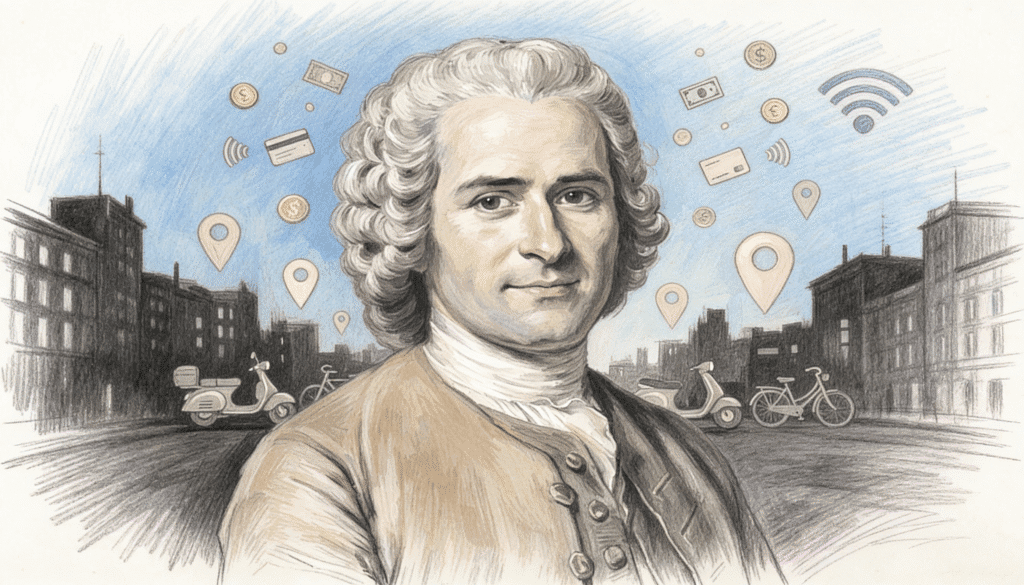
Jean-Jacques Rousseau wrote his famous line in 1762: “Man is born free, and everywhere he is in chains.” More than 250 years later, we’ve created something curious. We’ve built an economy that promises freedom above all else. You can work from anywhere. You can choose your own hours. You can be your own boss. The chains, we’re told, have been broken.
But Rousseau would probably laugh at us. Or maybe he’d just shake his head. Because the gig economy, for all its talk of liberation, might be the most Rousseauian trap we’ve ever built. We’ve convinced millions of people that they’re free while they’re actually more isolated, more insecure, and more chained to their work than ever before.
The Paradox of Freedom
Rousseau’s big idea was that humans in their natural state were free and good, but society corrupted them. We created institutions, property, and laws that trapped us. We gave up our natural freedom for the supposed benefits of civilization. And then we wondered why we felt miserable.
The gig economy sells itself as a return to that natural freedom. No more bosses breathing down your neck. No more office politics. No more mandatory meetings that could have been emails. You’re an independent contractor, a freelancer, a solopreneur. You control your destiny.
Except here’s the thing Rousseau understood: you can’t have freedom without community. Real freedom isn’t just the absence of a boss. It’s having actual choices. It’s having security. It’s being part of something bigger than yourself.
The gig worker sits alone in their apartment, staring at their laptop, waiting for the next ping from an app. They’re technically free. They can decline any job they want. They can work or not work. But can they really? When there are bills to pay and no safety net, that freedom starts to look a lot like a chain with extra steps.
The New Social Contract
Rousseau’s solution to the problem of freedom was the social contract. We agree to give up some individual freedom in exchange for the benefits of society. We follow laws, pay taxes, and participate in civic life. In return, we get protection, community, and a chance at collective flourishing.
Traditional employment was a kind of social contract. You gave the company your time and loyalty. They gave you a salary, benefits, maybe a pension. It wasn’t perfect. Many people felt trapped. But there was at least an exchange, a mutual obligation.
The gig economy threw that contract in the trash. Uber, DoorDash, Fiverr, and the rest didn’t want to be bound by obligations. They wanted all the benefits of having workers without any of the responsibilities. So they created a new language. These aren’t workers. They’re independent contractors. They’re partners. They’re part of a community.
But communities don’t exist on apps. You can’t build solidarity with people you never meet. You can’t organize when you’re competing with millions of others for the same gigs. You can’t negotiate when the algorithm decides your worth.
This is what Rousseau called the worst of both worlds. The gig worker has all the insecurity of natural freedom with none of its benefits. And they have all the constraints of civilization with none of its protections. They’re alone but not free. They’re working but not secure.
The Illusion of Independence
Here’s where it gets interesting. Many gig workers genuinely believe they’re more free than traditional employees. They talk about flexibility, autonomy, being their own boss. And they’re not entirely wrong. There is something liberating about not having to ask permission to take a day off or work from a coffee shop.
But Rousseau warned us about this kind of thinking. Just because you feel free doesn’t mean you are free. The most effective chains are the ones you don’t see. The ones you actually defend.
Take the Uber driver who insists they love the flexibility. They can work whenever they want. True. But they also have to work constantly to make rent. The algorithm controls their ratings, their access to rides, their income. One bad week and they’re desperate. One complaint and they’re deactivated. Is that really being your own boss? Or is it having a boss that never sleeps and never blinks?
The graphic designer on Fiverr thinks they’re running a business. They set their own rates. They choose their clients. But they’re competing in a global race to the bottom. Someone in another country will always do it cheaper. The platform takes 20 percent of everything they earn. They have no bargaining power, no recourse if a client refuses to pay.
This is what makes the gig economy so insidious. It takes the language of freedom and uses it to disguise dependency. It makes workers responsible for their own exploitation and calls it empowerment.
The Death of Community
Rousseau understood that humans are social creatures. We need community to thrive. We need relationships, shared experiences, common purpose. Isolation isn’t freedom. It’s a prison.
The old workplace had its problems. Office politics could be brutal. Bosses could be terrible. But it also provided something valuable: human connection. You had colleagues. You had water cooler conversations. You had someone to eat lunch with. You belonged to something.
The gig economy atomizes all of that. You work alone. Your colleagues are algorithms and automated messages. Your break room is your kitchen. Your team building is a Slack channel you never check. You’re free from the annoyances of coworkers. You’re also free from everything that makes work bearable.
Studies show that gig workers report higher rates of loneliness, anxiety, and depression. This shouldn’t surprise us. We’ve stripped away the social dimension of work and told people to be grateful for the efficiency. We’ve turned collaboration into competition. We’ve made everyone a small business of one, struggling to survive.
But here’s the counterintuitive part. Some people genuinely prefer it this way. They find traditional workplaces suffocating. They’d rather be alone than deal with bad managers and office drama. The gig economy works for them.
Rousseau would say these people are making the best of a bad situation. They’re choosing isolation because the alternative is so terrible. That doesn’t make isolation good. It just means we’ve failed to create communities worth belonging to.
The Question of Security
Freedom without security is just anxiety. Rousseau knew this. That’s why he argued for a strong social contract. Real freedom means knowing that if you get sick, you’ll be cared for. If you lose your job, you won’t starve. If you grow old, you’ll have dignity.
The gig economy offers none of this. No health insurance. No paid sick leave. No retirement benefits. No unemployment insurance. You’re free to work or not work, but you’re also free to fall through the cracks.
Companies justify this by saying gig workers can make their own choices. They can buy their own insurance. They can save for retirement. They’re adults. They can handle it.
But this ignores basic economics. Individual workers have no negotiating power. Insurance is expensive when you buy it alone. Retirement savings are impossible when you’re living paycheck to paycheck. The system is designed to make security unaffordable.
And when gig workers do fall on hard times, the response is predictable. They should have planned better. They should have saved more. They should have been more responsible. It’s always their fault, never the system’s.
This is Rousseau’s nightmare. A society that claims to value freedom while denying people the basic security that makes freedom possible. A world where your worth is determined by your last rating, your last gig, your last transaction.
The Myth of Meritocracy
The gig economy loves to tell stories about success. The entrepreneur who started with nothing and built an empire. The hustler who turned their side gig into a full time income. The creative who escaped the corporate grind and now lives their dream.
These stories are real. Some people do make it work. But they’re the exception, not the rule. For every success story, there are thousands of people barely scraping by, working multiple gigs, sacrificing sleep and health and relationships just to pay rent.
Rousseau would recognize this pattern. He wrote about how inequality gets baked into society and then justified as natural. The rich convince themselves they earned it through hard work and talent. The poor blame themselves for not working hard enough. Nobody questions the system itself.
The gig economy is pure meritocracy in theory. Everyone has equal access to the apps. Success depends only on your effort and skill. But in practice, it reproduces and amplifies existing inequalities. Those with resources can afford better equipment, better internet, better locations. Those without struggle from the start.
And the platforms keep a massive cut of everything. They own the infrastructure. They set the rules. They take their percentage whether you succeed or fail. It’s feudalism with better branding.
What Rousseau Would Say
If Rousseau could see the gig economy, he’d probably say we learned nothing from his work. We created a system that promises freedom but delivers isolation. We broke the social contract and replaced it with terms of service. We turned workers into atomized units competing against each other.
But he might also say something unexpected. The gig economy exposes the lie at the heart of traditional employment. That old social contract was already broken. Companies were already exploiting workers, just with better PR. At least the gig economy is honest about what it is.
This is the counterintuitive insight. The gig economy isn’t the problem. It’s the logical conclusion of treating workers as expendable. It’s what happens when we prioritize efficiency over everything else. It’s the end result of decades of weakening labor protections, busting unions, and treating people like resources.
Rousseau believed we could create a better social contract. One where freedom and community weren’t in conflict. Where individuals could flourish without being isolated. Where society provided security without crushing autonomy.
The gig economy proves we haven’t figured this out yet. We’re still stuck in the worst of both worlds. We have neither the freedom of the state of nature nor the security of civilization. We have apps and algorithms and the constant anxiety of not knowing where the next paycheck comes from.
So what do we do? Rousseau wouldn’t say we should go back. You can’t unring the bell. The gig economy exists because it solves real problems. Traditional employment was often rigid, hierarchical, and soul crushing. People wanted more flexibility, more autonomy, more control over their lives.
The answer isn’t to eliminate the gig economy. It’s to build a better social contract around it. One that preserves flexibility while providing security. One that allows for independence while maintaining community. One that recognizes that freedom and isolation are not the same thing.
This means portable benefits that follow workers between gigs. It means stronger protections against arbitrary deactivation. It means allowing gig workers to organize without being fired. It means making platforms share more of the value they extract.
It also means rethinking what work means in the first place. Maybe we don’t need everyone to work all the time.
Rousseau’s answer was clear. Freedom isn’t isolation. It’s participation in a community that respects your autonomy while providing for your needs. It’s having a voice in the decisions that affect your life. It’s knowing you belong to something larger than yourself.
The freelancer staring at their laptop isn’t free in this sense. They’re alone. They’re anxious. They’re one bad month away from disaster. They can work whenever they want, but they also have to work constantly. They’re independent, but they have no power.
Some people thrive in this environment. They like the autonomy, the variety, the lack of office politics. That’s valid. But we shouldn’t confuse individual adaptation with systemic success. Some people surviving doesn’t mean the system works.
Rousseau understood this 250 years ago. We’re still trying to figure it out. The gig economy is teaching us the lesson again, one isolated worker at a time. Freedom without community is just a nicer word for loneliness. Independence without security is just anxiety with better branding.
Being your own boss is great until you realize you’re also your own safety net, your own support system, your own everything.
The freelancer is free. The freelancer is also alone. Both things can be true. The question is whether we’re okay with that. And if we’re not, what are we willing to do about it?