Table of Contents
We have engineered boredom out of existence. Every pocket contains an escape hatch, every idle moment an opportunity to scroll, swipe, or stream. We treat empty time like a disease requiring immediate treatment. The cure? Another notification, another video, another hit of digital dopamine.
But what if we have made a terrible mistake?
Bertrand Russell, the British philosopher who died in 1970, never owned a smartphone. He never refreshed a social media feed or binged a streaming series. Yet his essay “In Praise of Idleness” reads like a warning label written specifically for our era.
Russell argued that our obsession with constant activity and productivity was not just exhausting but actively harmful to human flourishing. He suggested something that sounds almost offensive to modern ears: we should work less and do nothing more.
The suggestion lands strangely today. We live in a culture that treats busyness as a status symbol and rest as something to be earned, not freely taken. We wear exhaustion like a badge of honor. We apologize for taking vacations. We check email at dinner and answer Slack messages from bed. The idea of deliberately choosing boredom feels not just countercultural but almost immoral.
Russell understood this impulse. He knew that generations of cultural conditioning had taught us to fear idleness as the devil’s playground. But he also saw something we are only beginning to rediscover: that the empty spaces in our lives are not voids to be filled but gardens where our most important thoughts can grow.
The Tyranny of Busyness
Russell was writing in 1932, during the Great Depression, when millions of people wanted work but could not find it. His argument was partly economic: modern technology had made us so productive that we could maintain our standard of living while working far fewer hours. But the truly radical part of his thesis was psychological and philosophical.
He claimed that our devotion to constant work was not based on necessity but on a moral framework inherited from centuries past. We have been taught that idle hands are dangerous, that productivity equals virtue, that rest is something only lazy people crave. Russell saw these beliefs as chains that keep us from discovering what actually makes life worth living.
Consider how we spend a typical day. We wake to alarms, rush through mornings, commute while checking phones, work for eight or more hours, return home depleted, and then feel guilty for watching television instead of starting a side hustle or learning a new skill. Even our leisure time has become a form of work. We optimize our workouts, curate our social media presence, and turn our hobbies into potential income streams.
What are we running from? The answer, often, is ourselves. Boredom forces us to confront our own thoughts without the comforting static of constant stimulation. It asks us to sit with questions we might prefer to ignore. It reveals the gap between who we are and who we pretend to be. No wonder we reach for our phones every time a quiet moment threatens to emerge.
What Boredom Actually Does
Here is where Russell’s insight becomes truly interesting. He did not defend idleness because he thought people should be lazy. He defended it because he understood something about how human creativity and wisdom actually develop. They do not emerge from constant activity but from the spaciousness that allows reflection, imagination, and genuine thought.
Think about when your best ideas arrive. Probably not during your most frantically busy moments. They come in the shower. During a long walk. While staring out the window of a train. They emerge precisely when you stop trying to force them into existence. The mind needs room to wander before it can discover anything worth finding.
But the benefits run deeper than creativity. Boredom teaches emotional resilience. When we cannot immediately escape discomfort, we learn to sit with it. We discover that feelings pass, that restlessness does not require action, that we can survive our own company. These are not small skills. They are the foundation of emotional maturity.
Children who learn to play independently develop better problem solving abilities than those who require constant entertainment. Adults who can tolerate boredom report greater life satisfaction than those who always need external stimulation. The capacity to be alone with yourself without distraction is not a luxury. It is a prerequisite for knowing who you actually are.
The Paradox of Choice
Russell lived in a world with far fewer options than we have today. He could not understand the specific texture of modern overstimulation because he died before the internet existed. Yet his core insight applies with even greater force now. The more options we have for filling our time, the more we lose the ability to choose nothing at all.
This is one of the strange contradictions of modern life. We have unprecedented freedom to spend our leisure time however we want, yet that freedom has become a new kind of trap. Every moment contains dozens of possible activities, each competing for attention. The question is no longer whether to be entertained but which entertainment to select. We scroll through streaming menus for twenty minutes, unable to choose, already exhausted by the effort of deciding.
The presence of infinite options does not make us free. It makes us anxious. We worry about missing out on whatever we did not choose. We half experience whatever we did select because we are still wondering about the alternatives. We end up sampling everything and fully enjoying nothing.
Russell’s defense of idleness offers a way out of this trap. When you choose to do nothing, you eliminate the burden of choosing anything. You step off the treadmill of constant decision making and give your mind a chance to simply exist. This is not laziness. It is the radical act of refusing to treat every moment as a problem requiring a solution.
The Deepest Counterargument
Of course, there are good reasons to resist Russell’s advice. The most obvious is economic. Not everyone can afford to work less. The people who most need rest are often those who can least afford to take it. Russell himself acknowledged this problem. His essay was partly a call for restructuring society so that the benefits of technological productivity could be shared more widely rather than concentrated among the wealthy.
But even setting aside economic constraints, there is a deeper philosophical question. Does not meaning come from effort? Do not our greatest achievements require sustained work? Is there not something valuable about pushing ourselves beyond comfort?
These questions deserve serious answers. Russell was not arguing against all work or all effort. He was arguing against the ideology that treats work as inherently noble regardless of what it accomplishes. He distinguished between useful work that improves life and useless work that exists only to keep people busy. He also understood that the most meaningful human activities, whether raising children or creating art or pursuing knowledge, often look like idleness to those who measure value only through market productivity.
Consider what we actually remember from our lives. Few people on their deathbed wish they had spent more time at the office. They wish they had spent more time with people they love. They wish they had pursued interests that genuinely excited them rather than chasing external markers of success. They wish, in short, that they had devoted less energy to being productive and more energy to being fully human.
Russell was not advocating for a life of pure consumption and passive entertainment. He was advocating for a life that includes time for thought, conversation, beauty, and love. These things require space. They cannot be scheduled efficiently or optimized for maximum output. They unfold at their own pace or not at all.
The Recovery of Attention
One of the most profound effects of learning to tolerate boredom is the recovery of attention itself. We have become so accustomed to fractured, distracted awareness that we no longer notice its absence. We think we are paying attention when we glance at our phones every few minutes. We believe we are experiencing a movie when we watch it while also texting and checking email. We assume we are connecting with friends when we scroll through their curated highlight reels.
But attention is not the same as noticing. Real attention means sustained, undivided focus on whatever is present. It means experiencing a sunset without photographing it. It means having a conversation without monitoring your notifications. It means reading a book without wondering what else you could be doing. This kind of attention has become radical because it is so rare.
Boredom is the gateway back to attention. When you stop using constant stimulation as an anesthetic, you begin to notice what is actually happening around you and inside you. Colors become more vivid. Conversations become more engaging. Books reveal depths you previously missed. This is not because these things have changed but because you have finally shown up for them.
Russell understood that our deepest experiences require presence. You cannot think profound thoughts while distracted. You cannot forge meaningful relationships while half engaged. You cannot discover who you are while constantly performing for an audience. All of these require the kind of sustained attention that only develops when you give yourself permission to be bored.
What To Do With Nothing
The practical question remains: what does choosing boredom actually look like? Russell’s answer would surprise many modern readers. He was not suggesting we spend all day staring at walls or cultivating a zen like emptiness. He was suggesting that when freed from excessive work, people would naturally pursue activities that bring genuine satisfaction rather than merely killing time.
He imagined people reading philosophy, studying science, creating art, engaging in conversation, or simply thinking carefully about their lives. These activities require something our constant busyness prevents: the mental and emotional space to pursue interests for their own sake rather than for external reward.
This is harder than it sounds. When we first try to do nothing, we often feel restless, anxious, or vaguely guilty. This is not a sign that we are doing it wrong. It is evidence of how deeply the ideology of constant productivity has shaped us. The discomfort is withdrawal from the stimulation we use to avoid ourselves.
The goal is not to suffer through boredom but to pass through it into something else. On the other side of that initial restlessness lies curiosity. Questions emerge: What do I actually want to do with this time? What have I been too busy to notice? What thoughts have I been avoiding? These questions do not have easy answers, but they are the right questions. They lead toward a life shaped by genuine choice rather than habit and obligation.
Living With Limits
Russell’s essay contains one final insight worth considering. He argued that much of our frantic activity stems from fear of our own limitations. We stay busy to avoid confronting the fact that our time is finite, our energy is limited, and we cannot do everything. We treat productivity as if it could solve the problem of mortality.
But this strategy fails. No amount of optimization or efficiency can change the fundamental truth that we are finite beings in a vast universe. Accepting this limitation is not depressing. It is liberating. Once you acknowledge that you cannot do everything, you can finally choose what actually matters.
Boredom forces this reckoning. When you stop filling every moment with activity, you must face the reality of your limits. You must decide what deserves your limited time and energy. You must stop pretending that you can have it all or do it all or be it all. This clarity is painful but necessary. It is the difference between living someone else’s life and living your own.
The Choice We Face
Russell’s defense of idleness ultimately asks us to reconsider our priorities. Do we want lives filled with activity or lives filled with meaning? Do we want to be constantly stimulated or genuinely engaged? Do we want to stay busy or actually accomplish something worth doing?
These are not the same thing. Constant activity often prevents meaningful work. Constant stimulation often prevents genuine experience. The busy life and the good life are not synonyms. Sometimes they are opposites.
We cannot return to Russell’s world. Technology has changed how we work and live in ways he could not have imagined. But his central insight remains urgent: we have the choice to shape our lives according to our values rather than defaulting to the frantic busyness our culture prescribes.
That choice starts with the willingness to be bored. To sit with silence. To let moments pass without filling them. To resist the impulse to reach for distraction every time restlessness appears. This is not easy. Our entire culture militates against it. But it might be the most important resistance we can offer.
In the end, Russell was not praising idleness for its own sake. He was praising the kind of life that becomes possible when we stop treating every moment as a problem to be solved or a void to be filled. He was defending our right to exist without constantly justifying that existence through productivity. He was suggesting that being human might be enough.
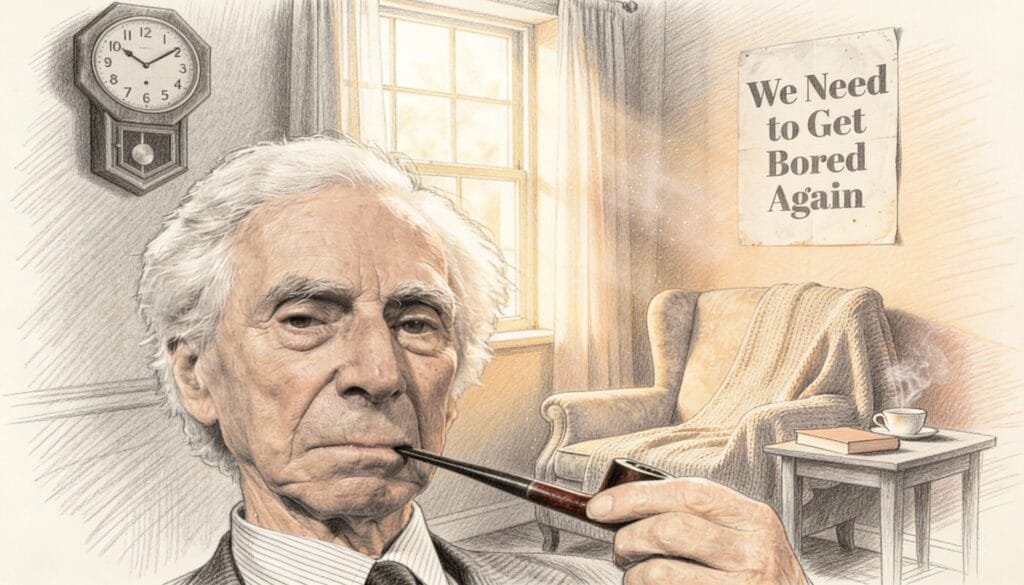
We need to hear this message now more than ever. The question is whether we have the courage to be bored again.
The answer might surprise us. It might even change us. But we will never know unless we give ourselves permission to find out.